
The Main Switch Circuit Breaker: Your Home’s Electrical Lifeline
SAN 10142-1 Specification
Overview
According to the ECA, the South African National Standards (SANS 10142-1) were officially written and set as the standard for premises electrical installations in 2001. The specification has undergone multiple iterations and has now set forth multiple rules, regulations, and guidelines for low-voltage installation.
Regarding acquiring the full specification, the SANS 10142-1 can be purchased on the official ECA website. Please find it here. If you’d like to get an overview of the specification, please read up on the history of the specification.
Low Voltage Installations
In accordance with SANS 10142-1, every residential and industrial low voltage electrical installation in South Africa is required to have a main switch disconnector on each distribution board, providing an immediately accessible means to disconnect the entire installation in an emergency, for maintenance, or in the event of a fault — as mandated under the Occupational Health and Safety Act.
The important of the SAN 10142-1 Specification
According to the SANS 10142-1 specification, residential and industrial electrical installations must have a distribution board (your DB) that provides an easily accessible means of disconnecting the main power supply to the house, industrial area, or specific niche installation, such as solar systems, in the event of an emergency.
This allows you, electricians, and any accredited electrical installer to easily disconnect power to troubleshoot faults without having to disconnect multiple sources of power.
Without this single source of truth, isolating faults and potential power hazards would be prevalent, increasing the resolution time and risk to anyone working on the installation.
Main Switch Circuit Breaker
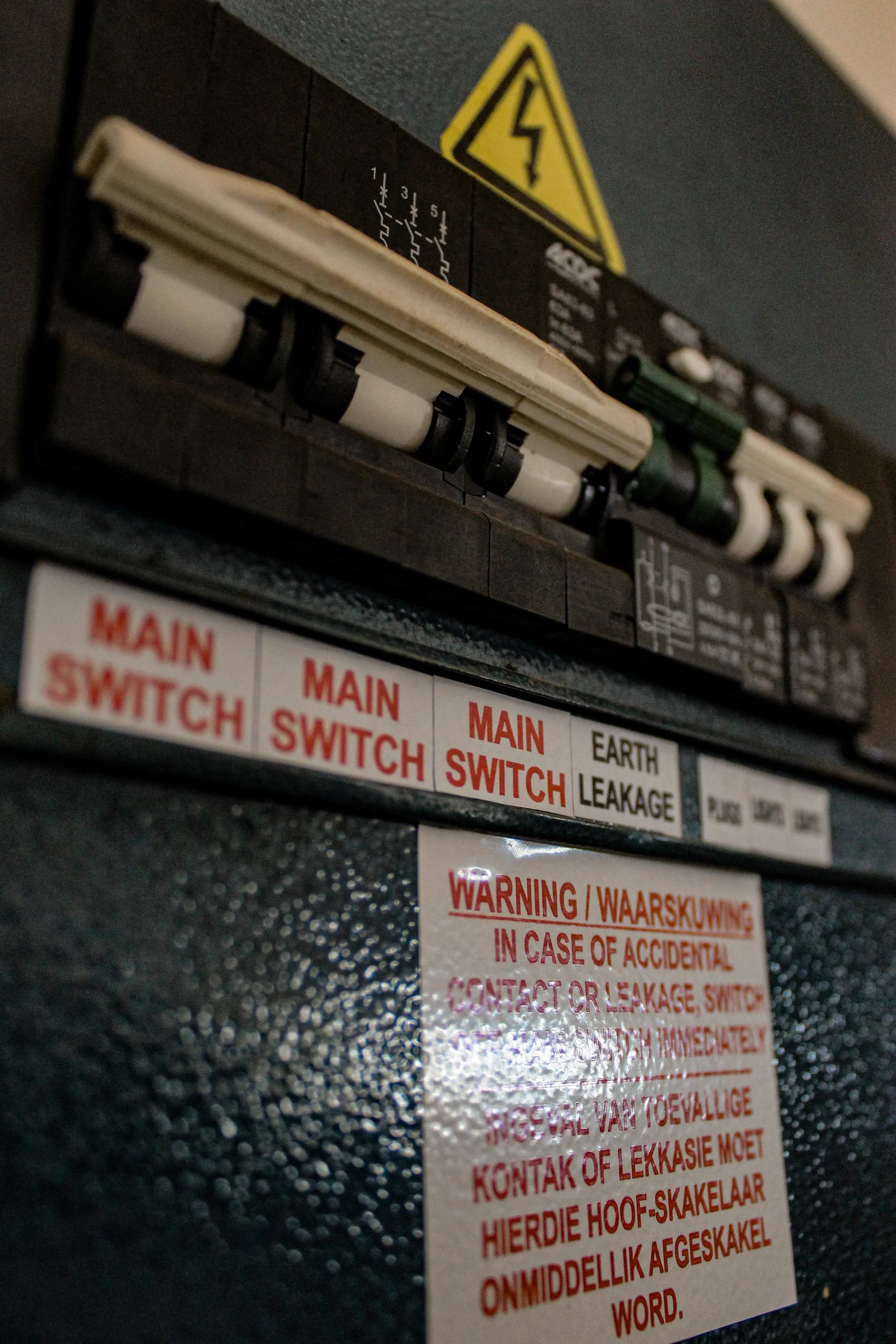
Photo by proudlyswazi on Unsplash
In the case of your home (residential), this main switch disconnector is the main switch circuit breaker.
That signature trip that you hear when loadshedding is over, or when you’ve got both the kettle and tumble dryer pulling a electrical load, is when the circuit breaker protects your electrical systems.
The main switch circuit breaker, based on the type of circuit breaker, will physically disconnect the contacts and sever the electrical connection to your home’s electrical circuit, protecting the entire home’s electrical systems from overcurrent, undervoltage, shock current, and even electrical arcs.
Where is the circuit breaker located?
As per the SANS 10142-1 specification, the main switch circuit breaker must be mounted:
- Main or First Distribution board (db): In the distribution board or adjacent to the distribution board in the same room as the distribution board itself. The circuit breaker itself must be labeled as “Main Switch”.
- Sub-distribution board: Same specification as a main distribution board although the circuit breaker must be labelled as “sub-main switch” or “main switch” if the board is labelled “sub-board”.
- Alternative Supply: Same specification as main distribution board although the circuit breaker must be labelled as “main switch” and must have a notice displayed at it stating that an alternative supply is connected to the installation. Where the alternative supply only feeds certain circuits, a power-on indicator (visible or audible) must also be provided on the distribution board, along with a notice stating that the standby power main switch must also be switched off in an emergency.
- Danger Notice: A danger notice must be provided near or on the circuit breaker that provides instructions that the breaker be switched off in the “event of inadvent contact or leakage”.
Most likely, you’ll find your main switch circuit breaker near or in the distribution board, with a danger notice and labelled as “main switch” for your home (residentual).
Regarding non-residentual installations or other international electrical installations, typical locations would be in the distribution board, near distribution boards, electrical panels, or near electrical meters.
Summary
Main Switch circuit breakers are required as per the SANS 10142-1 specification in low-voltage installations to provide an easy means of powering off the entire installation, making it easier to troubleshoot faults and safer by allowing a single point of power shutoff in emergency cases.
As a homeowner or installer, you can find the main switch circuit breaker near or in a distribution board in residential low-voltage installations.
The main switch circuit breaker’s purpose is to disconnect power to the entire electrical installation in cases of electrical surges, overcurrent, or electrical arcs. Protecting the underlying electrical system
Need a circuit breaker for your next project? Browse our full range and find the right fit.